Did having children and siblings help older adults survive in historical Finland?
Family members are often assumed to protect older adults' health and longevity. Using genealogical records of Finns born in 1740–1859, we examined whether having living children and siblings was associated with survival after age 50. Merely having a child or sibling alive did not guarantee longer life but certain family constellations did matter, and siblings became beneficial for survival in older age.
In modern societies, the presence of family members is generally associated with longer life. Family members can provide emotional and practical support, encourage healthier behaviors, and offer opportunities for social integration, all of which promote physical and mental health in later life. However, it remains understudied whether the same protective mechanisms of family members beyond spouses worked in the past. Historically, older people were an integral part of families as extended families with several generations living under one roof were common, and other relatives often lived nearby.
We expected that having at least one living child or sibling would be associated with a reduced risk of death in later life. Unlike their peers without children, parents may enjoy social and financial support and later-life care provided by their children. Sibling ties may not be as strong as ties between parents and children, but siblings are known to provide help and care when needed.
The caregiving potential of family members may also depend on who they are. Women generally provide more care than men and this applies to daughters compared with sons, and to sisters compared with brothers. In some historical societies, the youngest daughter was even expected to remain in her parents’ home and postpone or forgo marriage to care for them in old age. Male relatives mattered too, particularly for instrumental support, which may have been especially important for survival in the pre-industrial period. It might also have been advantageous to have children or siblings of both sexes, since they could provide different types of support. We therefore expected that having at least one living daughter or sister, or a mixed-sex group of children or siblings, would be associated with a lower risk of death.
The importance of family members likely grows with age. As health deteriorates, children typically respond by providing more care. Sibling relationships also vary over the life course: contact and exchange of help decline in young adulthood, stabilize in midlife, and rise again in later life, often prompted by life transitions such as losing a partner or worsening health. We thus expected having children and siblings, especially daughters and sisters, to become increasingly advantageous for survival with age.
We used a genealogical dataset constructed from historical records on births, deaths, marriages, and migrations collected by the Lutheran church in Finland from the eighteenth century onwards. We focused on 6,900 individuals born in Finland between 1740 and 1859 who survived to age 50, and followed their survival year by year up to age 90 using discrete-time hazard models. For each year, we knew whether individuals had living children and siblings which helped us track how their family networks changed as they aged.
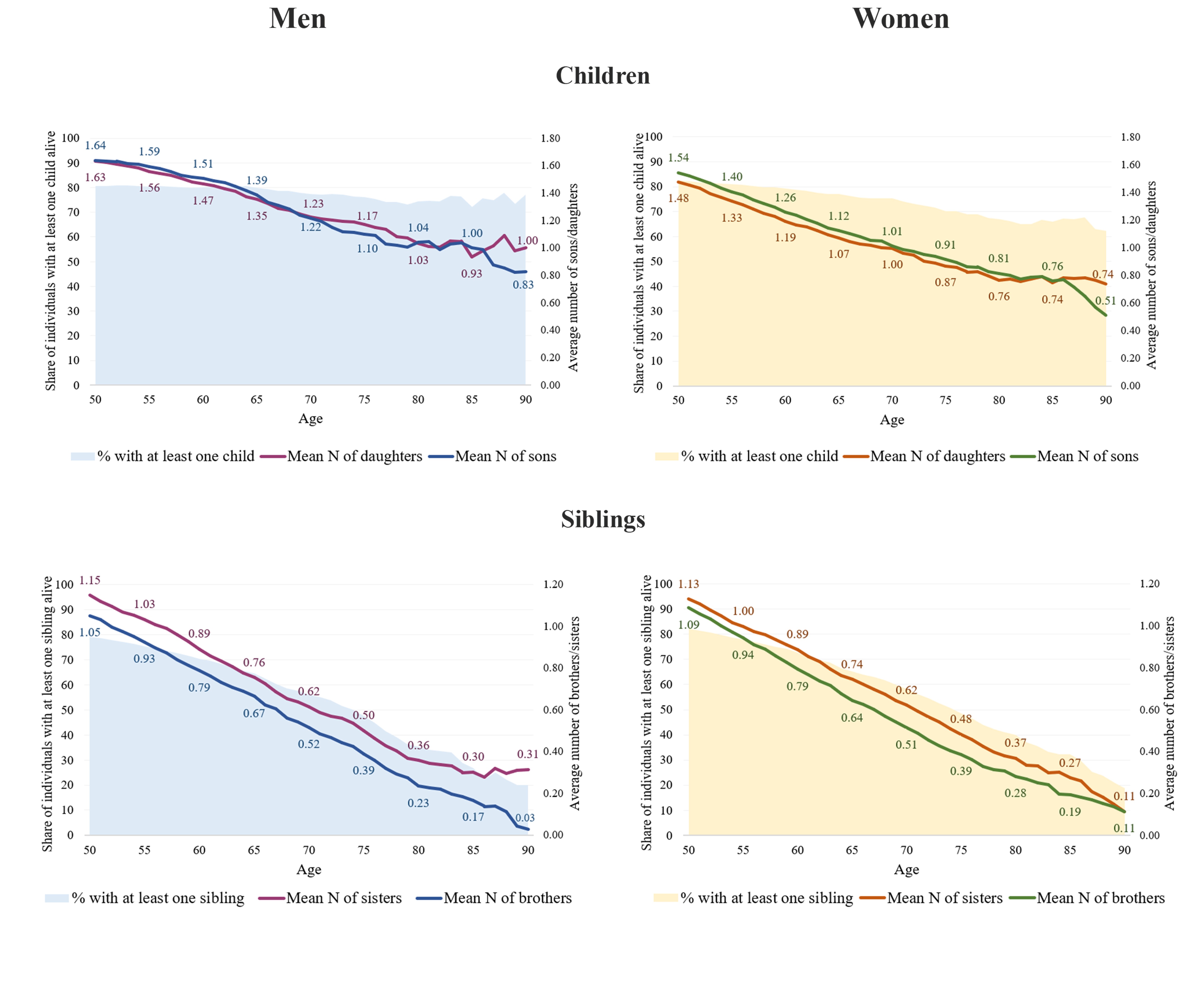
At age 50, around 80 per cent of men and women had at least one living child, and a similar share had at least one living sibling (Figure 1). On average, 50-year-olds had about three living children and slightly more than two living siblings. Many had a mixed-sex group of living children (52 per cent of men and 44 per cent of women) and siblings (around 30 per cent of both sexes). As people aged, the number of living children and siblings declined — and the decline was much steeper for siblings, who belonged to the same generation and aged alongside the individuals themselves.
Contrary to our expectations, simply having at least one living child or sibling was not clearly associated with a lower risk of death after age 50. For men, having at least one living child pointed towards a survival advantage, but the evidence was weak; for women, no association was found. We found no indication that the childless faced a higher risk of death in later life than parents in pre-industrial Finland.
The composition of the kin mattered more than just having a particular family member. Men with several living children of different sexes had a lower risk of death than men with no living children, perhaps because sons and daughters could provide different types of support. For women, no similar advantage of any particular gender composition of children emerged.
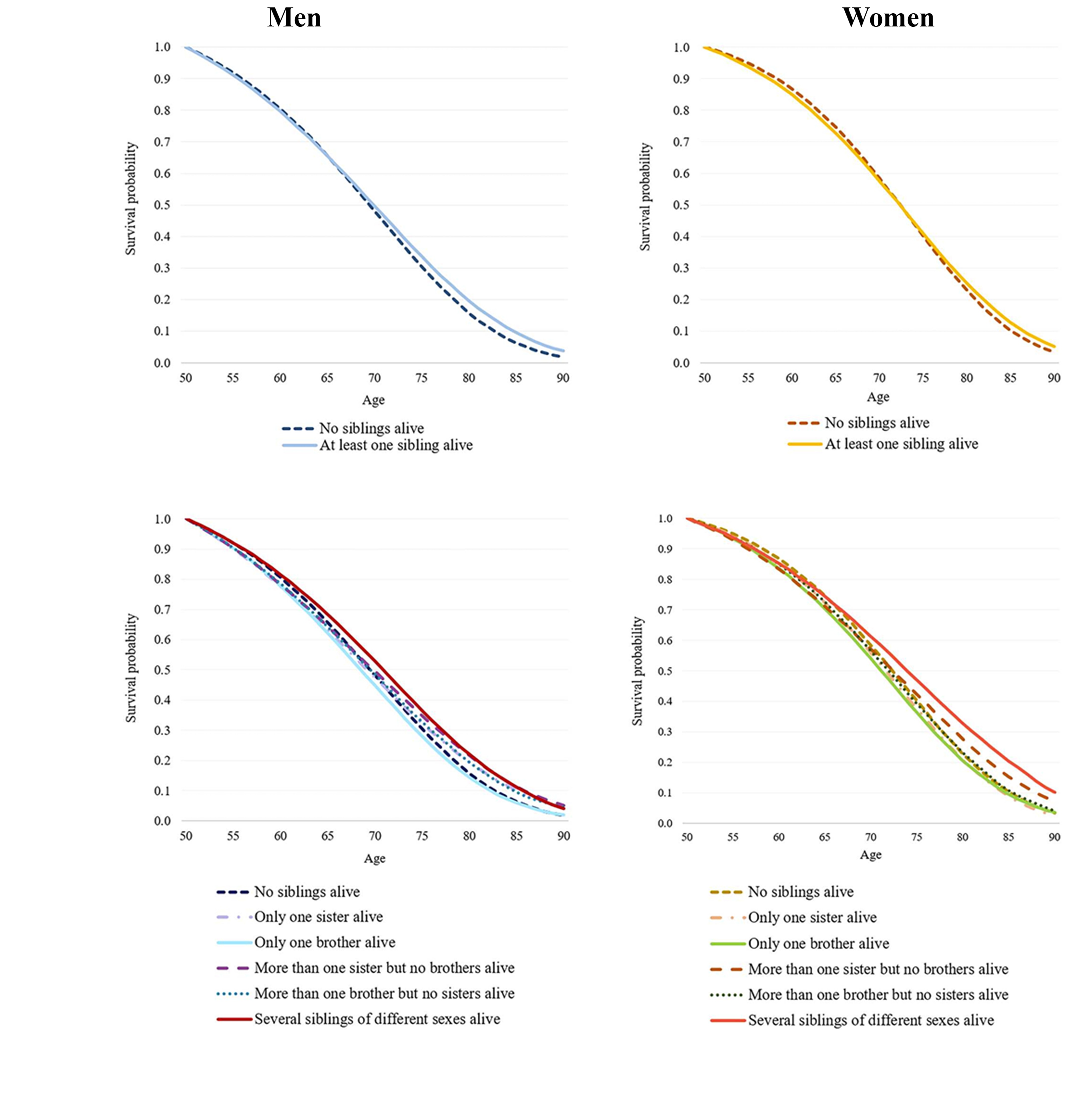
The most striking finding concerned the presence of siblings and age (Figure 2). At age 50, having at least one living sibling was, if anything, associated with a slightly higher risk of death. But the pattern reversed as people grew older: siblings became beneficial for survival at around age 66 for men and age 73 for women. As for the gender composition of the sibling group, having one sister (for men), several sisters (for both sexes), or a mixed-sex group of siblings (for women) became advantageous for survival with increasing age. This supports the idea that sibling cooperation intensifies as health declines, and that sisters in particular served as an important safety net in old age.
Our findings suggest that the protective role of family networks is not universal but depends on who the family members are and at what stage of ageing they are present. The result about the growing importance of siblings, especially sisters, with age echoes contemporary findings on sibling support in later life and suggests that sibling ties have long been an underexplored dimension of later-life support.
More information
Alyona Artamanova, researcher
alyona.artamonova@vaestoliitto.fi
Reference
Artamonova, A., Salonen, M., Hiraoka, T., Lahdenperä, M., Saramäki, J., Rotkirch, A., & Lummaa, V. (2026). The role of living kin in later-life survival: Evidence from Finnish historical data. Population Studies, 1–20. https://doi.org/10.1080/00324728.2026.2699960
How to cite
Artamonova, A. (2026). Did having children and siblings help older adults survive in historical Finland? Science Leak article 4/2026. Helsinki: Väestöliitto, Population Research Insitute. Available: https://www.vaestoliitto.fi/en/articles/did-having-children-and-siblings-help-older-adults-survive-in-historical-finland/ [Cited: ##.##.20##].
The research is part of the The Social networks, fertility and wellbeing in ageing populations: Building demographic resilience in Finland (NetResilience) project. The research has received funding from the Strategic Research Council within the Academy of Finland.